How long do dental implants last?
How long dental implants last according to long-term studies, why the crown on top may need replacing before the implant, what raises the risk of failure, and how to look after an implant after treatment abroad.
Plan my tripKey points
- Most dental implants are still in place after 10 years. A 2019 systematic review put 10-year survival at 96.4%, or 93.2% once patients lost to follow-up were accounted for.
- The implant and the crown on top are separate parts. The crown, and the screw that holds it, can wear or loosen and be replaced without removing the implant.
- Smoking and radiotherapy are linked to more implant failures. A history of gum disease is linked to late failure. Well-controlled diabetes was not linked to more failures in the reviews we read.
- Infection around an implant (peri-implantitis) is the main long-term threat. Regular professional cleaning and daily home care help prevent it.
- After treatment abroad, take your implant details home and book a check with your dentist so the implant is looked after from the start.
Most dental implants last many years. A 2019 systematic review in the Journal of Dentistry pooled 18 long-term studies and estimated that 96.4% of implants were still in place after 10 years. When the authors allowed for patients who dropped out of the studies, the estimate was 93.2%. How long an implant lasts for you depends on your health, whether you smoke, how well you clean around it, and how often a dentist checks it.
This guide explains what those numbers mean, which parts of an implant wear out, what raises the risk of failure, and how to look after an implant once you're home from treatment in Vietnam.
What the research says
| Study | What it found |
|---|---|
| Howe, Keys and Richards, Journal of Dentistry, 2019 (18 studies) | 96.4% of implants survived 10 years. A more cautious analysis gave 93.2%. People aged 65 and over may have about double the risk of implant loss. |
| Del Fabbro et al., Journal of Clinical Medicine, 2019 (34 studies, at least 5 years) | Implants loaded with teeth within a week of placement had a mean survival of 97.4% after an average of about 6 years. |
"Survival" in these studies means the implant was still in the mouth. It doesn't mean nothing went wrong: an implant can survive with a crown that has been replaced, or with some bone loss around it. Research beyond 10 years is limited, so be wary of anyone who promises an implant will last a lifetime.
The implant and the crown are separate parts
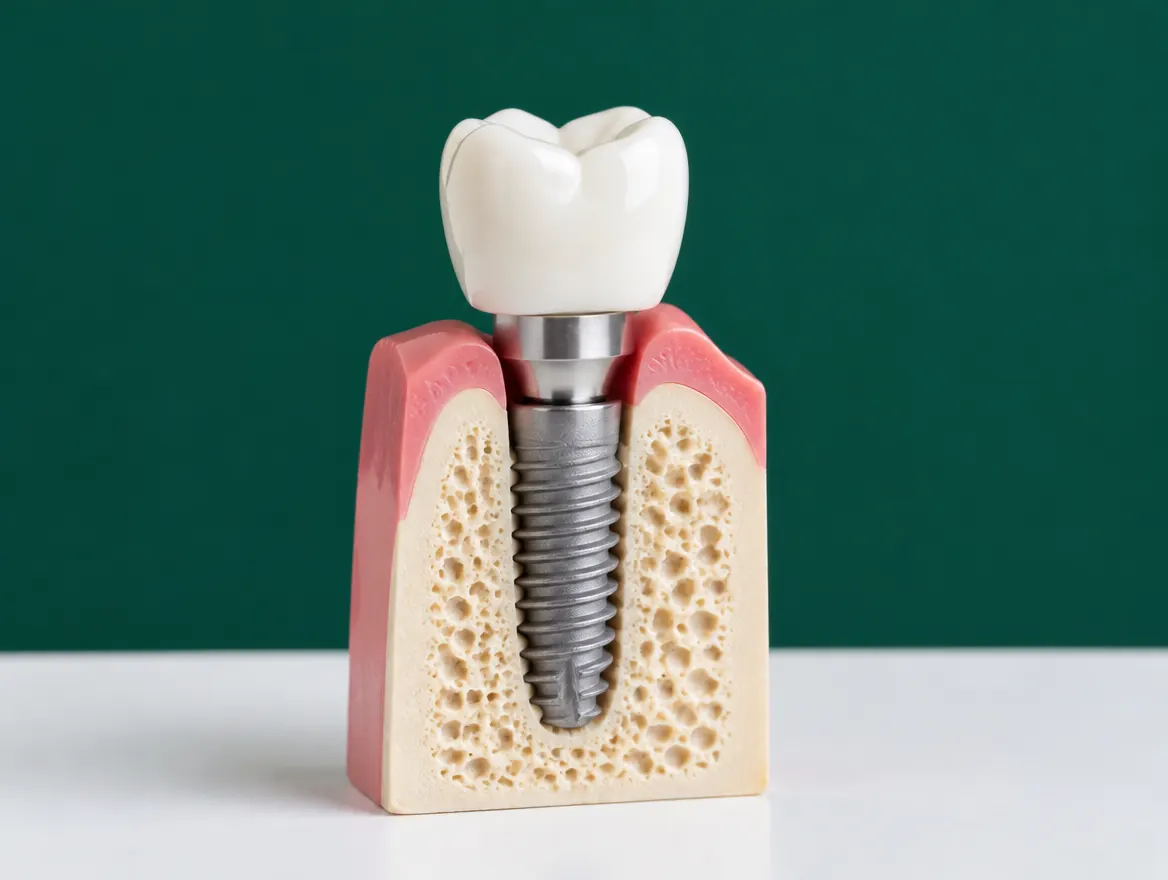
An implant has three parts. The post sits in the jawbone. The abutment connects the post to the tooth. The crown is the visible tooth on top.
The post is the part studies measure. The crown and the screw that holds the abutment take the force of every bite, and they are the parts most likely to need attention. A clinical review in International Scholarly Research Notices explains that uneven or heavy biting forces can loosen the abutment screw and damage the crown. A dentist can usually tighten the screw or make a new crown without touching the implant in the bone.
That matters after treatment abroad. Ask your clinic for the implant brand, model and size, and the abutment details. Your dentist at home needs them to order matching parts. Our guide to aftercare at home has the full list of records to bring back.
What shortens an implant's life
| Factor | What the research says |
|---|---|
| Smoking | A 2013 meta-analysis of 33 studies found smokers had almost twice the risk of implant failure (relative risk 1.92). The American Dental Association also says tobacco slows healing. |
| Radiotherapy to the head and neck | The same meta-analysis found a higher risk of failure (relative risk 2.28). |
| History of gum disease | A 2020 systematic review found a history of periodontitis was an important risk factor for late failure, although one included study found no link. |
| Tooth grinding (bruxism) | The 2020 review listed bruxism as a risk but said the evidence was inconclusive. Heavy biting forces can loosen screws and damage crowns. |
| Diabetes | The 2013 meta-analysis found no increase in failure with diabetes, and the 2020 review found controlled diabetes made no significant difference. The ADA says chronic illnesses such as diabetes may interfere with healing after surgery, so your surgeon will want to know. |
| Infection around the implant | Peri-implantitis causes bleeding, pus, deeper pockets, bone loss and, eventually, a loose implant, according to the 2014 clinical review. |
| Age 65 and over | The 2019 review found a possible doubling of the risk of implant loss in older age groups. |
Sources don't all agree. Smoking is the most consistent finding. Some individual studies in the 2020 review didn't show a significant link with smoking, but the authors still advise caution. If any of these apply to you, say so when you send your records to a clinic, and ask how they would change the plan.
How to make an implant last
At home
The 2014 clinical review recommends cleaning implants twice a day with a soft toothbrush or a gentle power brush. Use interdental brushes with a plastic-coated wire, because bare metal can scratch the implant's surface. Ask the hygienist to show you how to clean around your implant, and to check your technique at each visit.
At the dentist
The same review suggests a professional maintenance visit of about an hour every three months, with the gum around the implant measured every three to four months in the first year after the crown goes on. Your dentist may set a different interval once the implant is stable. A 2020 review also found that keeping to a maintenance plan after surgery improves outcomes.
Habits
- Stop smoking, or at least cut down, before and after surgery.
- If you grind your teeth, ask your dentist whether a night guard would protect the implant.
Signs of a problem
See a dentist promptly if you notice:
- bleeding when you brush around the implant
- swelling, pus or a bad taste near it
- a gap opening up between the gum and the implant
- a crown or implant that feels loose or moves when you bite
Problems caught early are easier to treat. If the implant was placed abroad, contact the clinic too: a written warranty should say what it covers and how to claim.
Planning implants in Vietnam with the long term in mind
How long an implant lasts starts with the plan. Before you book, ask the clinic:
- Which implant system do you use, and is it sold in my country?
- Will I get the implant and abutment details in writing?
- Do I need a bone graft or sinus lift first?
- How long should I wait before the final crown goes on?
- What does your warranty cover, and for how long?
Most implant cases need two trips, the second one usually 3 to 6 months after the first. Dental implants explains each stage, and planning your visits shows how long to stay. You can see a sample two-trip implant schedule in the trip planner.
Frequently asked questions
How long do dental implants last?
Most last many years. A 2019 systematic review in the Journal of Dentistry estimated that 96.4% of implants were still in place after 10 years, or 93.2% when the authors allowed for patients who dropped out of the studies. Research beyond 10 years is thinner, so nobody can promise a lifetime.
Do dental implants last forever?
They can last for decades, but not every implant does. The bone and gum around an implant can become infected, and the crown on top can wear, chip or come loose. How you look after the implant, and how often a dentist checks it, makes a difference.
Does the crown on an implant need replacing?
Sometimes. The crown and the screw that connects it are separate from the implant in the bone. Heavy biting forces can loosen the screw or damage the crown, and a dentist can usually repair or replace these parts without removing the implant.
What makes dental implants fail?
In the research we read, smoking and radiotherapy to the head and neck were linked to more failures, and a history of gum disease was linked to late failure. Infection around the implant (peri-implantitis) and too much force on it, for example from tooth grinding, can also cause problems.
Can you get an implant if you smoke?
Often yes, but the risk is higher. A 2013 meta-analysis found smokers had almost twice the risk of implant failure. Tell your surgeon if you smoke, and ask whether stopping before and after surgery would help.
Do implants last as long in older people?
The ADA says your general health matters more than your age when deciding whether implants suit you. The 2019 review did find a possible doubling of the risk of implant loss in people aged 65 and over, so check-ups matter even more.
How often should implants be checked?
Your dentist will set the interval. One clinical review recommends a professional maintenance visit every three months, with closer checks in the first year after the crown is fitted.
What are the signs of a problem with an implant?
Bleeding or pus from the gum around the implant, swelling, a deeper gap between the gum and the implant, or an implant or crown that feels loose. See a dentist promptly, as early treatment is easier.
Sources
- Howe, Keys and Richards, Journal of Dentistry (2019). Long-term (10-year) dental implant survival: A systematic review and sensitivity meta-analysis.
- Chen et al., PLoS One (2013). Smoking, radiotherapy, diabetes and osteoporosis as risk factors for dental implant failure: a meta-analysis.
- Do et al., International Journal of Environmental Research and Public Health (2020). Risk factors related to late failure of dental implant: a systematic review of recent studies.
- Gulati et al., International Scholarly Research Notices (2014). Implant maintenance: a clinical update.
- American Dental Association (MouthHealthy). Dental implants.
This article is general information, not medical advice. A dentist who has examined you is the right person to recommend treatment.
More in Dental care in Vietnam: Dental implants explained
See allAll-on-4 dental implants: how they work, and having them done in VietnamHow All-on-4 dental implants replace a full arch of teeth with a fixed bridge on four implants, what the studies show, and how to plan the trips to a clinic in Vietnam. Full mouth dental implants: your options comparedThe ways to replace all your teeth with implants, from individual implants to fixed full-arch bridges and removable implant dentures, and how to plan treatment in Vietnam.
 Implant-supported dentures and snap-on dentures: how they workHow implant-supported and snap-on dentures clip onto implants, how many implants they need, the attachment types, the upkeep, and how treatment in Vietnam is planned.
 Dental implant healing stages, from extraction to final crownThe stages of dental implant treatment and healing, how long each one usually takes, when immediate loading is an option, and how the stages fit into two trips to Vietnam.